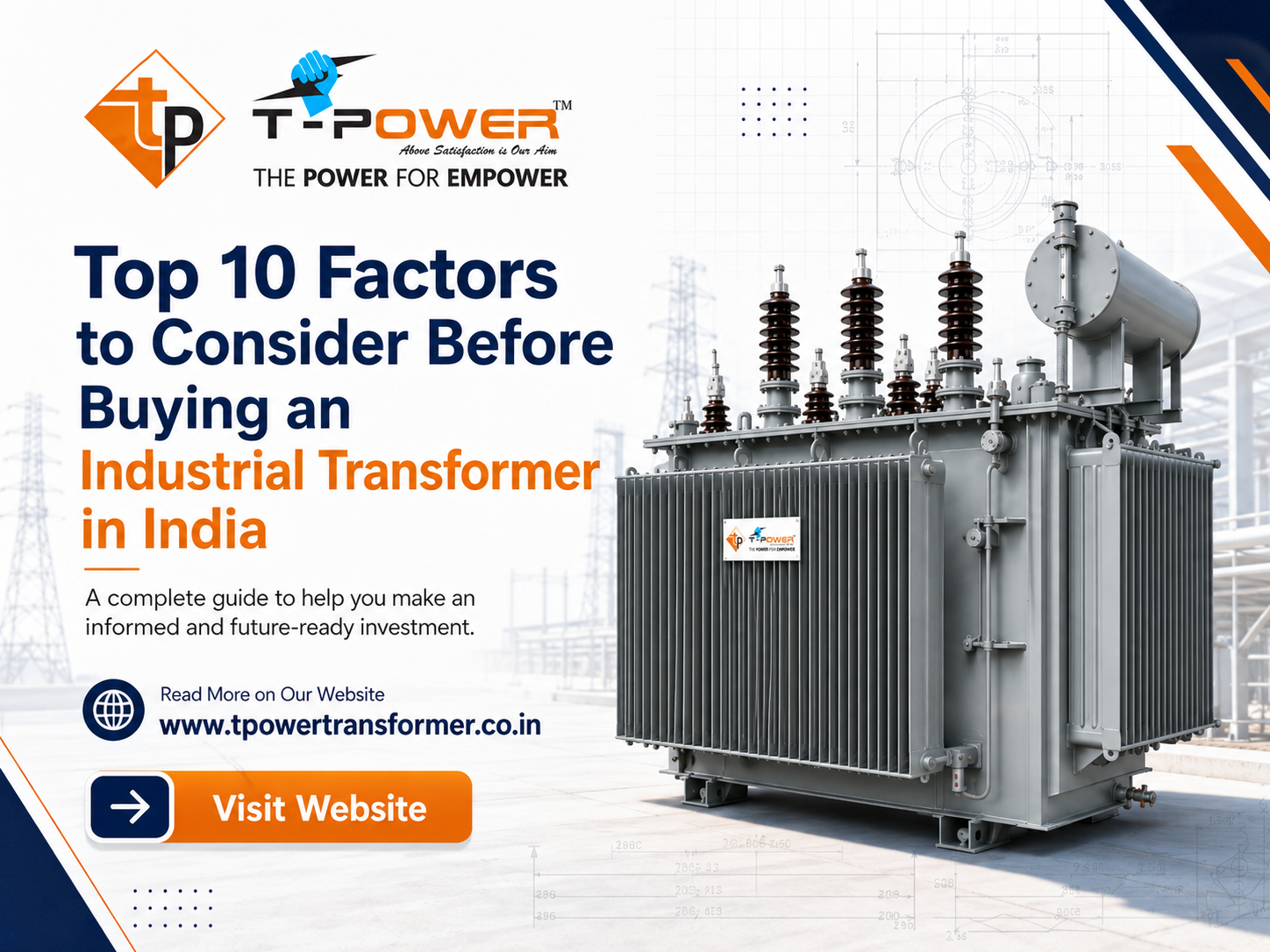
Top 10 Factors to Consider Before Buying an Industrial Transformer in India
Buying an industrial transformer is a major technical and financial decision for any factory, solar plant, manufacturing unit, infrastructure project, commercial facility, mining site, steel plant, cement plant, textile unit, chemical plant, or renewable energy project. A transformer is not just an electrical product; it is the heart of power distribution. If the transformer is selected correctly, your plant runs smoothly with stable voltage, reduced losses, better safety, and long service life. But if the wrong transformer is purchased, it can cause overheating, voltage fluctuation, production loss, high maintenance cost, breakdowns, and even safety hazards.
This detailed 2026 guide explains the Top 10 Factors to Consider Before Buying an Industrial Transformer in India. Whether you are purchasing a power transformer, distribution transformer, inverter duty transformer, oil immersed transformer, dry type transformer, or custom industrial transformer, these points will help you make a better and safer buying decision.
At T Power Transformer, we understand that every industry has different load conditions, voltage requirements, installation environment, and safety expectations. That is why transformer selection should always be based on proper technical study, not only on price.
Why Choosing the Right Industrial Transformer Matters in 2026
India’s industrial sector is growing fast in 2026. Manufacturing units, renewable energy plants, data centers, infrastructure projects, EV charging networks, solar parks, and process industries all require reliable power systems. In this environment, the demand for efficient and durable transformers has increased. Industries now prefer transformers that offer low losses, strong insulation, better cooling, safety compliance, custom design, and long operational life.
A transformer may look like a one-time purchase, but its effect continues for many years. A low-quality transformer may save some money during purchase, but it can increase electricity loss, downtime, repair cost, oil leakage risk, and production disturbance. A well-designed transformer, on the other hand, gives better performance, lower running cost, and peace of mind.
Before buying an industrial transformer in India, you should check technical specifications, load requirement, manufacturer credibility, testing facility, certification, after-sales support, and long-term efficiency. The following 10 factors will help you select the best transformer for your project.
1. Understand Your Load Requirement and Transformer Capacity
The first and most important factor before buying an industrial transformer is the correct capacity selection. Transformer capacity is usually measured in kVA or MVA. If you choose a transformer with lower capacity than required, it may get overloaded, heat up, trip frequently, and fail early. If you choose a transformer with much higher capacity than required, your investment cost may increase unnecessarily.
Industries should calculate their connected load, running load, future expansion load, motor starting current, peak demand, diversity factor, and power factor before selecting transformer capacity. For example, a small manufacturing unit may require a 250 kVA or 500 kVA transformer, while a large plant may require 1000 kVA, 1600 kVA, 2500 kVA, 5 MVA, or higher capacity transformer.
In 2026, many industries are also planning future expansion, solar integration, automation, and additional machinery. Therefore, transformer sizing should not be based only on current load. A proper margin should be considered so that the transformer can handle future demand without frequent replacement.
Tip: Always share your load details with an experienced industrial transformer manufacturer in India before finalizing capacity.
2. Check Voltage Ratio and Application Requirement
The second key factor is voltage ratio. Industrial transformers are designed to step up or step down voltage according to application. Common voltage combinations include 11 kV/433 V, 22 kV/433 V, 33 kV/433 V, 66 kV/440 V, 33 kV/11 kV, 11 kV/690 V, and many other custom ratings.
The voltage ratio depends on your incoming supply voltage and required output voltage. For example, if your factory receives 11 kV supply and your equipment requires 415 V or 433 V, you need a step-down transformer. If you are working with solar plants, wind projects, or power evacuation systems, you may require step-up transformers or inverter duty transformers.
Wrong voltage selection can damage machinery, cause voltage instability, affect motor performance, and create safety issues. Therefore, voltage ratio should be finalized according to utility supply conditions, industrial machinery requirements, and project design.
Different industries need different transformer types. A steel plant may need a furnace duty transformer, a solar plant may need an inverter duty transformer, a factory may need an oil immersed distribution transformer, while a commercial building may prefer a dry type transformer. Always match the transformer type with your exact application.
3. Select the Right Transformer Type
Before buying an industrial transformer in India, you must decide which type of transformer is suitable for your installation. The common transformer types used in industries include oil immersed transformers, dry type transformers, power transformers, distribution transformers, inverter duty transformers, furnace duty transformers, rectifier duty transformers, and special purpose transformers.
Oil immersed transformers are widely used in industrial and outdoor applications. They provide good cooling, high efficiency, and long service life. These transformers are suitable for factories, utilities, solar plants, mining projects, and heavy industries.
Dry type transformers are generally preferred for indoor installations, commercial buildings, hospitals, malls, data centers, and locations where fire safety is a major concern. They do not use transformer oil and are safer for sensitive environments.
Power transformers are used for higher voltage and large capacity applications. These are common in substations, power plants, large industrial units, and grid systems.
Distribution transformers are used to distribute electrical energy at usable voltage levels for industrial, commercial, and residential applications.
Inverter duty transformers are specially designed for solar and renewable energy systems where inverter output needs to be handled safely and efficiently.
Choosing the wrong type of transformer may reduce efficiency and increase maintenance. So, always consult a technical expert before finalizing the transformer category.
4. Focus on Energy Efficiency and Losses
Transformer efficiency is one of the most important factors in 2026. Since transformers operate continuously for years, even small losses can result in high electricity cost over time. Transformer losses are mainly divided into no-load losses and load losses.
No-load losses occur even when the transformer is energized but not supplying load. Load losses occur when current flows through the winding during operation. A low-quality transformer may have higher losses, which increases power consumption and operating cost.
Industries should always ask for loss values before purchasing a transformer. A transformer with low initial price but high losses may become expensive in the long run. Energy-efficient transformers help reduce electricity bills, improve plant performance, and support sustainability goals.
In India, many buyers now prefer BIS-compliant and energy-efficient transformers because they support long-term cost saving. For factories operating 24x7, transformer efficiency should be treated as a serious buying factor.
Recommendation: Do not compare transformers only by price. Compare losses, material quality, winding design, insulation, testing standards, and life cycle cost.
5. Check Winding Material: Copper or Aluminium
Another important factor before buying an industrial transformer is winding material. Transformers are generally manufactured with copper winding or aluminium winding. Both materials are used in India, but their selection depends on budget, application, performance expectation, and project requirement.
Copper winding transformers offer better conductivity, lower losses, compact design, better thermal performance, and higher mechanical strength. They are preferred for heavy-duty industrial applications, continuous operation, and high reliability requirements.
Aluminium winding transformers are generally more economical and can be suitable for certain applications where budget is a major factor. However, design quality, conductor size, and manufacturing standards must be checked carefully.
For industries where downtime is costly, copper wound transformers are often preferred. For projects where cost optimization is important, aluminium transformers can also be considered if manufactured with proper design and testing.
Before finalizing, ask your transformer manufacturer to explain the difference in losses, weight, size, cost, and performance between copper and aluminium winding options.
6. Verify Standards, Certifications and Testing
Transformer safety and performance depend heavily on manufacturing standards and testing. Before buying an industrial transformer in India, always check whether the transformer is designed and tested as per relevant Indian and international standards such as IS, IEC, BIS, and customer-specific requirements.
A reliable transformer manufacturer should provide routine test reports, design details, technical drawings, and quality documents. Important transformer tests may include ratio test, winding resistance test, insulation resistance test, oil test, load loss test, no-load loss test, impedance test, temperature rise test, dielectric test, and vector group verification.
Testing is not a formality. It confirms whether the transformer is safe, efficient, and ready for operation. Without proper testing, hidden defects may appear after installation, causing breakdown and loss.
In 2026, industrial buyers are becoming more quality-conscious. They prefer manufacturers with proper testing facilities, experienced engineers, quality inspection process, and documented compliance.
Important: Never buy an industrial transformer without checking test reports and quality assurance documents.
7. Consider Cooling Method and Installation Environment
Cooling is a critical part of transformer performance. During operation, transformers generate heat. If heat is not removed properly, insulation life reduces and failure risk increases. The cooling method should be selected according to capacity, load pattern, ambient temperature, and installation environment.
Common cooling methods include ONAN, ONAF, AN, AF, and other special cooling arrangements. ONAN stands for Oil Natural Air Natural and is common in many oil immersed transformers. ONAF stands for Oil Natural Air Forced and uses fans for improved cooling at higher loads.
For outdoor installations, the transformer should be designed to handle dust, rain, heat, humidity, and site conditions. For indoor installations, ventilation, fire safety, noise level, and space availability should be considered.
Industries located in hot regions of India, such as Rajasthan, Gujarat, Maharashtra, and parts of central India, should pay extra attention to ambient temperature and cooling design. Poor cooling can cause overheating, oil deterioration, insulation failure, and reduced transformer life.
Before purchase, share your site conditions with the manufacturer, including indoor/outdoor location, ambient temperature, altitude, ventilation, dust level, and load cycle.
8. Check Safety Features and Protection Accessories
Industrial transformers must be equipped with proper safety and protection accessories. These accessories help monitor transformer health and prevent major failures. Depending on transformer type and capacity, accessories may include oil temperature indicator, winding temperature indicator, magnetic oil level gauge, pressure relief valve, Buchholz relay, breather, marshalling box, radiator, conservator tank, cable box, rollers, earthing terminals, and protection relays.
Safety features are especially important for large industrial transformers because a fault can affect the entire plant. Proper protection helps detect overheating, oil level problems, internal gas formation, pressure rise, and insulation issues.
For dry type transformers, safety considerations may include temperature sensors, enclosure protection, ventilation, insulation class, fire safety rating, and installation clearance.
A good manufacturer will recommend safety accessories according to transformer rating and application. Do not remove essential safety components only to reduce cost. Saving a small amount during purchase may create a bigger risk later.
9. Evaluate Manufacturer Experience and Customization Capability
One of the biggest mistakes buyers make is selecting a transformer only based on quotation price. Industrial transformers should be purchased from an experienced and technically strong manufacturer. The manufacturer should understand industrial loads, voltage conditions, standards, testing, site requirements, and customization needs.
Every project is different. A cement plant, solar plant, textile unit, steel plant, food processing unit, hospital, commercial complex, and data center may all need different transformer designs. Therefore, customization capability is very important.
Before placing an order, check the manufacturer’s experience, product range, testing facility, customer support, engineering team, previous projects, manufacturing process, and service network.
T Power Transformer offers industrial transformer solutions for different applications including power distribution, industrial plants, renewable energy projects, inverter duty applications, and customized transformer requirements. The company focuses on quality, performance, safety, and long-term reliability.
When buying an industrial transformer in India, always choose a manufacturer who can provide technical guidance, not just a product.
10. Compare Total Cost, Warranty and After-Sales Support
Price is important, but it should not be the only deciding factor. The total cost of a transformer includes purchase price, transportation, installation, commissioning, energy losses, maintenance, downtime risk, repair cost, spare parts, and service life.
A cheaper transformer with poor efficiency may cost more over its lifetime. A transformer with better design and lower losses may have slightly higher initial price but can save money through reduced energy consumption and better reliability.
Warranty and after-sales support are also very important. Industrial transformers may require inspection, oil filtration, testing, maintenance, troubleshooting, and spare parts support. If the manufacturer does not provide proper service, your plant may face delays during breakdowns.
Before purchase, ask about warranty period, service support, spare availability, installation guidance, commissioning support, and maintenance recommendations.
Best buying approach: Compare technical quality, efficiency, testing, manufacturer reputation, warranty, and after-sales service along with price.
Industrial Transformer Buying Checklist 2026
| Factor | What to Check | Why It Matters |
|---|---|---|
| Capacity | kVA/MVA rating, current load, future expansion | Prevents overload and underutilization |
| Voltage Ratio | Input and output voltage requirement | Ensures correct power distribution |
| Transformer Type | Oil immersed, dry type, power, distribution, IDT | Matches transformer with application |
| Efficiency | No-load loss and load loss values | Reduces long-term electricity cost |
| Winding Material | Copper or aluminium | Affects performance, cost and life |
| Standards | IS, IEC, BIS compliance | Confirms safety and quality |
| Testing | Routine and special test reports | Ensures reliable operation |
| Cooling | ONAN, ONAF, dry type ventilation | Controls temperature and improves life |
| Safety Accessories | OTI, WTI, PRV, Buchholz relay, breather | Protects transformer from faults |
| Manufacturer Support | Warranty, service, customization | Improves reliability and support |
Common Mistakes to Avoid While Buying an Industrial Transformer
Many buyers make mistakes during transformer purchase because they focus only on price or basic rating. Below are some common mistakes that should be avoided:
- Buying transformer without proper load calculation
- Selecting capacity without considering future expansion
- Ignoring transformer losses and efficiency
- Choosing wrong voltage ratio
- Not checking test reports and certifications
- Comparing only price instead of technical specifications
- Ignoring cooling and installation environment
- Removing safety accessories to reduce cost
- Buying from inexperienced suppliers
- Not confirming warranty and after-sales support
A transformer is a long-term asset. A smart purchase decision can protect your plant from unnecessary downtime and electrical problems.
Best Transformer for Different Industrial Applications
Different industries require different transformer solutions. A textile plant may need a stable distribution transformer for continuous machinery operation. A solar plant may require an inverter duty transformer designed for inverter output and renewable energy conditions. A steel or furnace industry may require a furnace duty transformer with strong mechanical and thermal design. A commercial complex may prefer a dry type transformer because of safety and indoor installation needs.
Here are some common industrial applications:
- Manufacturing Plants: Distribution and power transformers for machinery load
- Solar Projects: Inverter duty and step-up transformers
- Steel Industries: Furnace duty transformers
- Cement Plants: Heavy-duty power transformers
- Commercial Buildings: Dry type or compact transformers
- Mining Projects: Rugged transformers for harsh environments
- Data Centers: High reliability transformers with stable output
- EV Charging Stations: Transformers designed for modern electrical load
Why Choose T Power Transformer?
T Power Transformer is a trusted name for industrial transformer solutions in India. The company focuses on quality manufacturing, technical design, energy efficiency, safety, and customer-specific transformer requirements.
Whether you need a distribution transformer, power transformer, inverter duty transformer, oil immersed transformer, dry type transformer, or custom-built industrial transformer, T Power Transformer can support your project with reliable engineering and manufacturing expertise.
Key strengths of T Power Transformer:
- Custom transformer design as per project requirement
- Industrial-grade manufacturing quality
- Energy-efficient transformer solutions
- Reliable testing and quality control
- Support for industrial and renewable energy applications
- Focus on long service life and safe operation
- Technical guidance before final selection
If you are searching for the Top 10 Factors to Consider Before Buying an Industrial Transformer in India, this guide gives you the right direction. But for final selection, expert consultation is always recommended.
Frequently Asked Questions
1. What is the most important factor before buying an industrial transformer?
The most important factor is correct capacity selection based on connected load, running load, future expansion, voltage requirement, and application type. Wrong capacity can cause overload, high losses, and breakdowns.
2. Which transformer is best for industrial use?
The best transformer depends on application. Oil immersed transformers are widely used for outdoor industrial applications, dry type transformers are preferred for indoor safety-sensitive locations, and special transformers are used for solar, furnace, or rectifier applications.
3. Should I choose copper or aluminium winding transformer?
Copper winding offers better conductivity, lower losses, and strong performance. Aluminium winding can be cost-effective for selected applications. The choice depends on budget, load condition, efficiency requirement, and long-term usage.
4. Why are transformer losses important?
Transformer losses affect electricity cost. A transformer with lower losses saves money over its lifetime and improves energy efficiency. Buyers should compare no-load losses and load losses before purchase.
5. How do I choose the right transformer manufacturer in India?
Choose a manufacturer with experience, proper testing facilities, quality standards, customization capability, technical support, warranty, and after-sales service. T Power Transformer provides industrial transformer solutions for different applications.
Conclusion
Buying an industrial transformer in India requires careful planning. In 2026, industries need transformers that are efficient, safe, reliable, future-ready, and suitable for specific applications. The Top 10 Factors to Consider Before Buying an Industrial Transformer in India include capacity, voltage ratio, transformer type, efficiency, winding material, standards, testing, cooling, safety accessories, manufacturer experience, warranty, and after-sales support.
A transformer is not just an electrical machine. It is a long-term investment in your plant’s performance and safety. Choosing the right transformer can reduce losses, improve voltage stability, avoid downtime, and support smooth industrial operations.
Looking for a reliable industrial transformer manufacturer in India? Contact T Power Transformer today for customized, efficient, and high-performance transformer solutions for your project.

