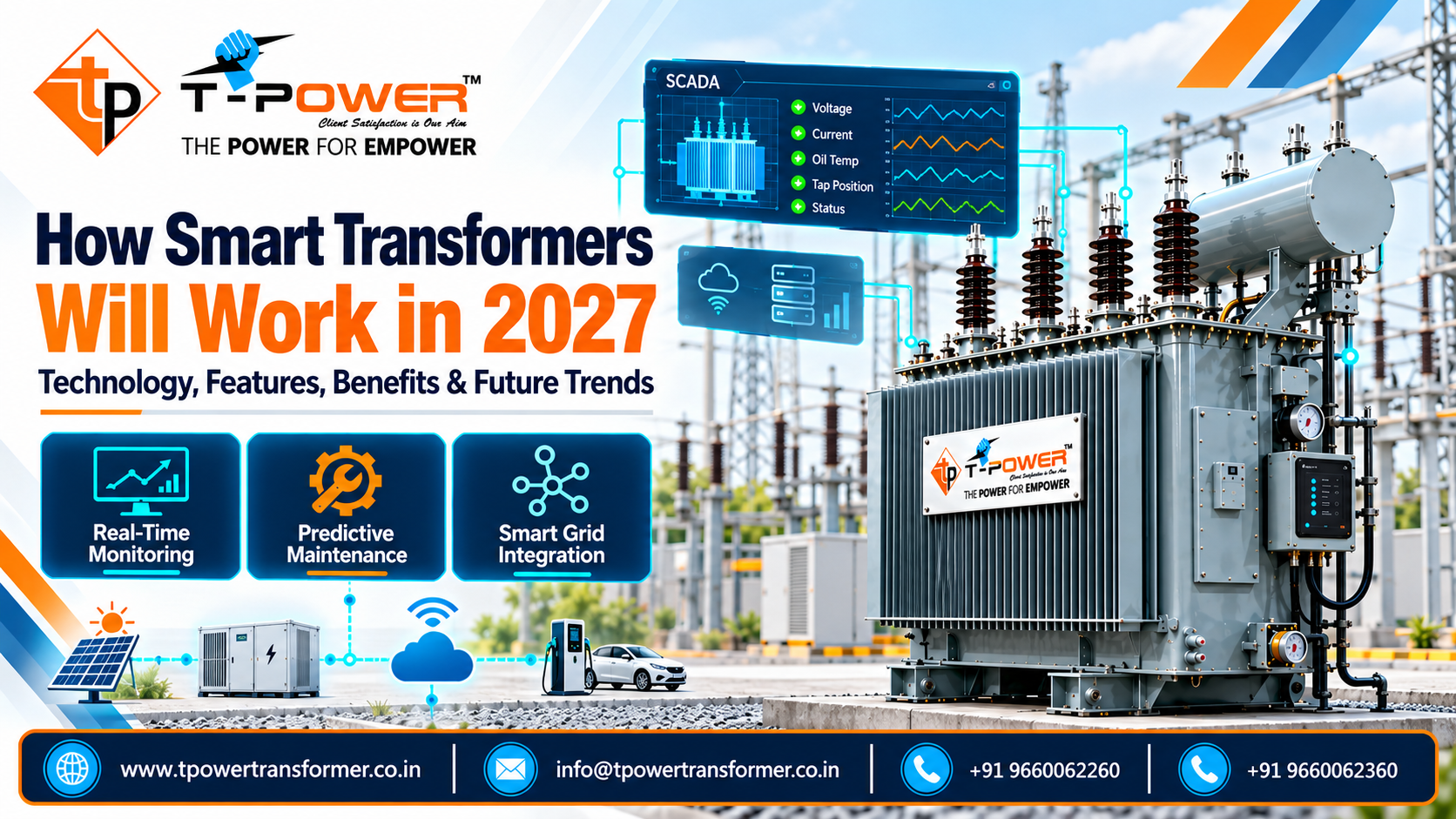
How Smart Transformers Will Work in 2027 | Technology, Features, Benefits & Future Trends
Electricity networks are becoming more dynamic. Solar power plants, battery energy storage systems, electric vehicle charging stations, data centres, automated factories and bidirectional power flows are changing what utilities and industrial operators expect from transformer assets. A transformer can no longer be viewed only as passive equipment that changes one voltage level into another. By 2027, many new transformer projects will be planned with digital visibility, connected sensors, condition-based maintenance and integration with plant or grid-control platforms from the beginning.
This does not mean that every transformer installed in 2027 will be a futuristic solid-state machine. In practical projects, the term smart transformer will continue to cover two related but different technologies. The first is a conventional electromagnetic transformer equipped with sensors, intelligent electronic devices, communication gateways and analytics. The second is a power-electronics-based solid-state transformer capable of actively controlling voltage, power flow and power quality.
Understanding this distinction is essential for anyone searching for How Smart Transformers Will Work in 2027. A smart solution is not created merely by attaching an internet connection to a transformer. It requires reliable sensing, meaningful data, suitable communication protocols, secure system architecture, properly configured alarms and a maintenance process that converts information into action.
T Power Transformer supports transformer requirements for industrial, distribution, power and renewable-energy applications. This guide explains the working principle, important components, 2027-ready features, business benefits, limitations, applications, selection criteria and a practical implementation itinerary for organisations planning intelligent transformer assets.
What Is a Smart Transformer?
A smart transformer is a transformer system that combines core electrical transformation functions with digital measurement, communication, monitoring and decision-support capabilities. It can collect operating data, detect abnormal conditions, communicate information to authorised systems and help engineers make faster maintenance or operating decisions.
Depending on its design, a smart transformer may also support remote configuration, automated control, active voltage regulation or power conversion. The exact meaning of “smart” therefore depends on the transformer construction, application and the digital functions included in the project specification.
In a sensor-enabled conventional transformer, the magnetic core, windings, insulation system and cooling arrangement still perform the primary transformation duty. Sensors and intelligent devices add visibility around that physical equipment.
These sensors may monitor load current, voltage, top-oil temperature, winding temperature, oil level, pressure, moisture, dissolved gases, tap-changer operations, cooling status, vibration or environmental conditions. A gateway then sends selected data to a SCADA, energy-management, asset-management or cloud platform.
A solid-state transformer, sometimes called a power-electronic transformer, uses high-frequency conversion stages and semiconductor switching. It can potentially provide active voltage control, DC interfaces, bidirectional operation, power-quality functions and more flexible integration with distributed energy resources.
However, cost, efficiency at rated conditions, thermal management, protection coordination, semiconductor reliability and service capability must be assessed for the actual application. A solid-state transformer should not be selected only because it appears more advanced.
Smart Does Not Mean Fully Autonomous
Smart transformers can automate data collection and support alarms, but responsibility still rests with qualified engineers and operators. A prediction is not the same as a confirmed fault diagnosis.
Automated recommendations should be checked against operating context, transformer design, loading history, maintenance records and validated test results. In 2027, dependable transformer installations will combine digital intelligence with disciplined engineering judgement.
How Smart Transformers Will Work in 2027: Complete Data-to-Decision Cycle
The practical operation of a smart transformer can be understood as a continuous cycle. The transformer performs its electrical duty while field devices measure selected parameters. Edge equipment validates and organises the data.
Secure communication systems deliver useful information to the appropriate platform. Software converts readings into trends, alarms and maintenance insights. Engineers then act on those insights and record the outcome, improving the quality of future decisions.
| Stage | What Happens | Practical Output |
|---|---|---|
| 1. Electrical Operation | The transformer changes voltage and carries the connected load. | Voltage, current, power, losses and thermal behaviour |
| 2. Sensing | Sensors measure electrical, thermal, mechanical and insulation-related conditions. | Time-stamped field measurements |
| 3. Edge Processing | A local device filters, validates and aggregates measurements. | Usable data, local alarms and event records |
| 4. Secure Communication | Approved data moves to SCADA, DMS, EMS, historian or asset platforms. | Remote visibility and system integration |
| 5. Analytics | Models compare current behaviour with limits, history and peer assets. | Alerts, trends, health indicators and maintenance priorities |
| 6. Engineering Action | Qualified personnel inspect, test, adjust loading or schedule maintenance. | Reduced uncertainty and documented intervention |
1. Sensing the Transformer in Real Time
Sensors form the foundation of a smart-transformer system. Their purpose is not to measure everything possible. Their purpose is to capture the parameters that matter for the asset’s design, duty and failure risks.
For an oil-immersed power transformer, this may include temperature, oil level, pressure, cooling operation, online dissolved-gas indicators and bushing condition. For a dry-type transformer, winding temperature, enclosure temperature, fan operation, load, humidity and partial-discharge monitoring may be more relevant.
Measurement quality is critical. A low-quality or incorrectly installed sensor can create false alarms or hide a developing condition. Therefore, the specification should define accuracy, range, environmental rating, calibration, sampling interval, power supply, communication interface and replacement method.
A 2027-ready system should also preserve raw or high-resolution event data where it is valuable rather than keeping only a simplified dashboard score.
2. Edge Computing Near the Transformer
Sending every raw measurement to a distant cloud platform is not always practical. Bandwidth can be limited, network availability can vary and some alarms require a local response.
Edge computing places processing capability near the transformer. It can remove obvious noise, calculate rolling averages, detect threshold violations, store data during a communication outage and forward prioritised events when connectivity returns.
Edge processing also helps separate protection functions from advisory analytics. Fast protection should remain within suitable protection equipment and properly engineered schemes.
Cloud analytics can support planning and maintenance, but it should not casually replace deterministic local protection. Clear functional boundaries make the complete system safer and easier to test.
3. Interoperable Communication
A smart transformer becomes valuable when its information can be understood by other authorised systems. Interoperability means more than having an Ethernet port.
Data names, units, time stamps, event meaning, quality flags and device behaviour must be defined consistently. Depending on the project, integration may involve IEC 61850, Modbus, DNP3, OPC UA, MQTT or another approved protocol and data model.
The correct communication protocol depends on the operating environment. A utility substation has different requirements from a factory energy dashboard, commercial building or remote solar power plant.
Buyers should specify the destination system, required points list, update rates, time synchronisation, redundancy, network topology and commissioning tests before ordering. Otherwise, a device may be technically connected but operationally unusable.
4. Analytics and Condition Assessment
Analytics convert measurements into meaningful context. A fixed high-temperature alarm may be useful, but a trend showing that temperature is increasing at the same load and ambient condition can provide earlier warning.
Software can compare load against temperature, examine cooling-stage performance, identify repeated overloads, track tap-changer activity or highlight a change in gas behaviour.
By 2027, more systems will use machine-learning-assisted models, but the strongest applications will remain explainable. Maintenance teams need to understand why an alert was generated, which data supported it and what verification is recommended.
A black-box health score without traceable evidence can create unnecessary work or unjustified confidence.
5. Human Decision and Closed-Loop Improvement
The final stage is engineering action. The platform may recommend inspection, oil sampling, thermography, load review, connection tightening or a planned shutdown.
Engineers verify the condition and record their findings. If the alarm was accurate, the model gains useful feedback. If it was false, thresholds or data-quality rules can be improved.
This feedback loop is what turns a basic monitoring installation into a mature transformer asset-management system.
Key Smart Transformer Features Expected in 2027
Continuous Load and Voltage Monitoring
Connected meters will provide time-based visibility into phase current, voltage, active power, reactive power, power factor, frequency and unbalance.
Operators can identify recurring overloads, unexpected reverse power flow, poor power factor or voltage conditions that are difficult to understand from occasional manual readings.
This data can also support capacity planning and better utilisation of existing transformer assets.
Thermal Intelligence
Transformer insulation ageing is strongly influenced by temperature. Smart monitoring can combine measured top-oil or winding temperature with load and ambient conditions.
Instead of seeing one isolated temperature number, the operator can review trends, rate of rise, cooling response and recurring hot periods.
Where suitable models and inputs are available, the system may estimate thermal state or loss-of-life indicators for engineering review.
Online Condition Indicators
Critical transformer applications may use online moisture, dissolved-gas, bushing, partial-discharge or tap-changer monitoring.
Not every sensor is justified on every asset. The monitoring package should reflect transformer value, failure consequence, operating environment and maintenance strategy.
For a fleet of smaller distribution transformers, economical load and temperature monitoring may produce greater value than a complex premium sensor package on every unit.
Predictive Maintenance Support
Predictive maintenance does not promise an exact failure date. It uses condition and trend information to identify assets that deserve attention earlier than a fixed calendar would indicate.
A transformer showing stable behaviour may remain under normal observation, while a unit with rising temperature, frequent cooling alarms and abnormal loading can be prioritised for inspection.
The result is a more risk-based and condition-informed maintenance programme.
Remote Alarms and Mobile Visibility
Authorised teams may receive alarms through control-room systems, dashboards or managed mobile notifications.
Alarm design should include severity, acknowledgement rules, escalation paths and response instructions. Sending every minor change to every user produces alarm fatigue.
A 2027-ready design should focus on actionable notifications while preserving detailed data for technical investigation.
Digital Asset Records and Event History
Smart-transformer programmes can connect live data with nameplate details, drawings, factory test results, maintenance reports, oil-test history, photographs and spare-parts information.
This digital record helps a team understand not only what is happening now but also what changed over the transformer’s complete lifecycle.
Consistent asset identification is essential so information is never assigned to the wrong transformer.
SCADA, DMS, EMS and CMMS Integration
Transformer data should support existing operational processes. SCADA may display live status, a distribution-management system may use network information, an energy-management system may analyse demand, and a computerised maintenance-management system may create work orders.
Integration should be purposeful. Replicating every measurement into every platform increases complexity without necessarily improving operating decisions.
Cybersecurity by Design
Connectivity expands the cyber-attack surface. Smart transformer projects should apply network segmentation, role-based access, secure authentication, controlled remote access and encrypted communication where required.
The system should also include security logging, patch governance, configuration backups and incident-response procedures. Default passwords and permanently open vendor connections should not be accepted as normal operating practices.
Firmware and Configuration Management
A digital device has a lifecycle beyond physical installation. Owners need an inventory of firmware versions, approved configurations, update procedures, rollback plans and vendor-support periods.
Updates should be tested and authorised rather than applied informally. The project should also define what happens if a sensor or gateway becomes obsolete before the main transformer reaches the end of its service life.
Digital-Twin-Assisted Planning
The phrase digital twin can describe anything from a structured asset model to an advanced simulation updated by live operating data.
By 2027, practical transformer use cases may include comparing expected and measured thermal behaviour, assessing loading scenarios, visualising maintenance history and testing operational changes.
Buyers should request a defined function and data model rather than purchasing a vague “digital twin” label.
Conventional, Digitally Enabled and Solid-State Transformers Compared
| Category | Conventional Transformer | Digitally Enabled Smart Transformer | Solid-State Transformer |
|---|---|---|---|
| Primary Technology | Electromagnetic core and windings | Electromagnetic transformer plus sensors, IEDs and communication | Power-semiconductor conversion with high-frequency magnetic stages |
| Visibility | Manual readings or limited local indication | Continuous remote monitoring and event history | Continuous digital control and monitoring |
| Voltage Control | Fixed ratio or tap changer depending on design | Monitored tap control or coordinated voltage-management support | Potentially rapid electronic voltage regulation |
| Maintenance | Primarily calendar and inspection based | Condition-informed and risk prioritised | Module, cooling and electronics-focused strategy |
| Typical 2027 Position | Widely used | Increasingly practical for critical and connected assets | Specialised, pilot or application-dependent deployment |
| Main Selection Question | Does it meet electrical and lifecycle requirements? | Will the data create operational value securely? | Do active functions justify cost, complexity and risk? |
For most industrial and utility buyers planning near-term projects, a digitally enabled electromagnetic transformer will be the practical meaning of a smart transformer.
It preserves proven electrical transformation technology while adding measurable intelligence. A solid-state transformer should be considered where its active functions solve a defined problem that conventional equipment cannot address efficiently.
Major Benefits of Smart Transformers
Earlier Detection of Developing Problems
Periodic inspection provides a snapshot. Continuous monitoring can reveal a trend between inspections.
A cooling fan that operates inconsistently, a connection that gradually produces higher temperature or repeated overloads may become visible before the condition develops into an outage.
Monitoring does not eliminate failures, but it can reduce avoidable surprises when sensors and alarm logic are correctly selected.
Improved Maintenance Prioritisation
Maintenance resources are limited. Smart-transformer data helps technical teams focus on assets with stronger evidence of deterioration or abnormal operating duty.
This is particularly useful across a fleet where hundreds of transformers cannot receive the same level of attention at the same time.
Maintenance priority can reflect transformer condition, criticality, loading, redundancy and the potential consequence of failure.
Reduced Unplanned Downtime Risk
When warnings are converted into timely action, an organisation may plan work during a controlled shutdown instead of reacting to an unexpected interruption.
The financial value varies by site. For a continuous-process factory, data centre, hospital, railway system or renewable-energy evacuation transformer, avoiding even one major interruption can be significant.
Better Capacity and Loading Decisions
Actual loading data can show whether a transformer is underused, frequently overloaded or affected by strong phase imbalance.
Engineers can use this evidence when planning load transfers, capacity augmentation, solar additions, EV chargers or battery systems.
This is more reliable than making a major investment from a small number of manual readings.
Support for Energy Efficiency
Smart monitoring can identify poor power factor, phase unbalance, unnecessary energisation, abnormal cooling operation or loading patterns that influence losses.
It cannot change the transformer’s designed core and winding losses, but it can help the operator use the asset more effectively and detect deviations from expected performance.
Stronger Compliance and Documentation
Time-stamped records can support internal audits, maintenance evidence, incident investigations and warranty discussions.
Reliable digital records improve shift handovers and reduce dependence on individual memory. Data retention should follow business, regulatory and cybersecurity requirements rather than an arbitrary policy of storing everything forever.
Safer Maintenance Preparation
Remote information can help maintenance teams understand transformer conditions before approaching the equipment.
It does not replace isolation, lockout, earthing, testing or other electrical-safety procedures. However, knowing that pressure, temperature or an alarm has changed can improve planning and help select the right specialists.
Where Smart Transformers Will Be Used in 2027
Renewable-Energy Power Plants
Solar and wind power plants experience variable generation, daily thermal cycles and remote-site maintenance challenges.
Monitoring load, temperature, cooling status and alarms can help operators compare different transformer blocks and plan maintenance.
Data integration with plant SCADA can create a clearer view from inverter or turbine output to grid evacuation.
Battery Energy Storage Systems
Battery energy storage projects may charge and discharge according to market, grid or site requirements. This can produce bidirectional and rapidly changing transformer duty.
A smart monitoring system can record operating cycles, direction of power flow, load, temperature and electrical events. This helps engineers verify that actual duty remains within the approved transformer design basis.
Electric-Vehicle Charging Infrastructure
High-power EV charging hubs can create concentrated and time-dependent loads. Smart monitoring supports demand analysis, phase balancing, capacity planning and early identification of thermal stress.
Future coordination between charging controls, site energy storage and transformer capacity may reduce unnecessary peaks, provided the control logic and commercial objectives are properly defined.
Industrial Manufacturing Plants
Manufacturing facilities increasingly rely on automation, power electronics and high-availability processes.
Smart transformers can support energy dashboards, maintenance planning and analysis of changing load patterns. Industries should also examine harmonics, transient duty, ambient conditions and process criticality when specifying the transformer and monitoring package.
Data Centres and Critical Facilities
Data centres, hospitals, airports and communication facilities require dependable electrical power.
Transformer monitoring can be integrated into broader electrical and facility-management systems. Alarm routing, redundancy and cybersecurity are especially important because an incorrect remote command or ignored alert can have consequences beyond the transformer itself.
Utility Distribution Networks
Distribution networks are experiencing rooftop solar generation, batteries, flexible loads and reverse power flow.
Smart transformer data can improve visibility at locations where operators previously had limited measurement. Utilities can use this information for capacity assessment, voltage management, fault analysis and transformer fleet planning.
Microgrids
Microgrids can use transformer information when coordinating local generation, storage, critical loads and grid exchange.
However, the transformer should not be treated as a substitute for a complete microgrid controller. It is one important source of operating information within the larger electrical system.
Important Smart Transformer Trends for 2027
From Time-Based to Risk-Based Maintenance
Calendar maintenance will remain necessary for many tasks, but connected condition data will help refine priorities.
Organisations will increasingly combine transformer health, criticality, operating duty, spare availability and outage consequence. The trend is not maintenance-free equipment; it is better-informed maintenance.
More Edge Analytics
Local gateways will perform more calculations close to the transformer. This can reduce bandwidth use, support faster alarms and allow continued local monitoring during network interruptions.
Edge devices will require the same disciplined management as other operational technology, including secure configuration, backups, access control and supported firmware.
AI-Assisted Transformer Fleet Analysis
Artificial intelligence will be used to compare large transformer fleets, detect unusual patterns and rank maintenance attention.
Its value will depend on representative data, clear labels, quality control and engineering validation. Small or inconsistent datasets can produce misleading confidence.
Organisations should begin with measurable use cases and track whether recommendations actually improve maintenance and operating outcomes.
Stronger Interoperability Requirements
Buyers will expect equipment from different vendors to exchange understandable information.
Open and documented interfaces can reduce dependence on one proprietary platform, but the word “open” should be verified through point lists, data models, conformance claims and integration tests.
Interoperability should be a procurement deliverable rather than a marketing assumption.
Cybersecurity Procurement Clauses
Cybersecurity will move earlier into transformer and monitoring procurement.
Specifications may request secure development practices, vulnerability notification, supported update periods, access logging, credential management and a software bill of materials for relevant digital components.
The transformer owner must also maintain network and identity controls after project handover.
Integration with Solar, Storage and Flexible Loads
Smart transformers will operate within systems containing solar power, wind generation, batteries, EV charging and controllable demand.
Transformer data can support voltage management, capacity planning and operational coordination. Active control should be designed at the complete system level so separate devices do not respond in conflicting ways.
Modular Sensor and Gateway Upgrades
A transformer may remain in service for decades, while sensors, gateways and communication devices generally have shorter product cycles.
Future-ready transformer designs will allow digital components to be repaired or upgraded without replacing the main transformer.
Clear interfaces, accessible mounting arrangements and long-term vendor support will become important lifecycle considerations.
Selective Growth of Solid-State Transformers
Solid-state transformers may gain attention in applications needing compact conversion, DC coupling, rapid voltage control or specialised power-quality functions.
Adoption will not be uniform. Each project should compare efficiency across the actual duty cycle, cooling requirements, fault behaviour, redundancy, maintainability and total cost with established transformer alternatives.
Challenges and Limitations Buyers Should Understand
Smart functionality adds components and dependencies. Sensors can drift, networks can fail, software licences can expire and digital products can become obsolete.
A strong design should ensure that loss of a monitoring function does not unnecessarily interrupt the transformer’s safe basic operation. Critical alarms may require local indication or redundant communication paths.
Data volume is another challenge. Collecting millions of readings provides little value if no one owns alarm response or reviews operating trends.
Before adding a measurement point, the project team should ask what decision it will support, how frequently it is needed, where it will be stored and who will take action when it changes.
False-positive alarms can reduce trust. Thresholds copied from another asset may be inappropriate because transformer designs, climates and loading patterns differ.
Alarm settings should be based on manufacturer guidance, project requirements, baseline data and engineering review. They should be reassessed after sufficient operating experience.
Cybersecurity is both a technical and organisational responsibility. Secure products cannot compensate for shared passwords, unmanaged laptops, uncontrolled vendor access or flat communication networks.
At the same time, restrictions that prevent authorised maintenance can also create operational risk. Security governance should support secure and practical transformer maintenance.
Return on investment will vary from one application to another. A premium monitoring package may be justified for a critical MVA transformer but not for every small distribution transformer.
Benefits should be evaluated through avoided-risk value, inspection savings, operational improvement, downtime consequence and expected transformer service life. Smart design means selecting the right intelligence, not installing the maximum number of devices.
Smart Transformer Project Itinerary for 2027
The following implementation itinerary can help utilities, EPC contractors, renewable-energy developers and industrial buyers convert a general smart-transformer concept into a clear and testable project specification.
Step 1: Define the Business and Reliability Objective
State the problem first. Is the objective to reduce unplanned outages, monitor remote assets, manage renewable power flow, improve maintenance prioritisation or document transformer loading?
Clear objectives prevent unnecessary features and provide a basis for measuring project success.
Step 2: Classify Transformer Criticality
Assess load consequence, process dependency, electrical redundancy, replacement lead time, safety impact and repair difficulty.
Transformer criticality helps determine which sensors, communication paths and technical support arrangements are justified.
Step 3: Confirm the Electrical Transformer Specification
Digital features cannot correct an unsuitable electrical design.
Finalise transformer rating, voltage ratio, vector group, impedance, insulation level, cooling arrangement, temperature rise, tap arrangement, losses, installation environment and applicable standards before adding monitoring requirements.
Step 4: Perform a Failure-Mode and Monitoring Review
Identify credible transformer failure modes and decide which conditions can be meaningfully monitored.
Connect each proposed sensor with a maintenance decision or operating response. This creates a rational monitoring package instead of a collection of unrelated instruments.
Step 5: Define Data Points and Quality Requirements
Prepare a data-point schedule covering the point name, unit, measuring range, accuracy, sampling rate, time stamp, quality flag, alarm limits and storage period.
Include calculated values and event records where required. Agree on the ownership of engineering units and transformer asset identifiers.
Step 6: Design the Communication Architecture
Specify communication protocols, gateways, network paths, redundancy, time synchronisation, offline storage and destination systems.
Confirm whether the connection is only for monitoring or also includes authorised control. Document interfaces with SCADA, DMS, EMS, historian and maintenance-management systems.
Step 7: Build Cybersecurity into the Specification
Define user roles, authentication, encryption requirements, network segmentation, remote-access approval, logging, update support, configuration backup and incident handling.
Include cybersecurity requirements in vendor evaluation, factory testing and site acceptance testing.
Step 8: Establish Alarm Philosophy and Response
Categorise transformer alarms according to urgency and assign a responsible response owner.
Define acknowledgement, escalation and investigation steps. Separate advisory alerts from trip and protection functions.
Ensure that control-room and maintenance teams understand the meaning and required response for each alarm.
Step 9: Review Vendor Capability and Lifecycle Support
Evaluate transformer manufacturing capability, sensor integration, software support, documentation, communication protocol implementation, spare availability and service capability.
Ask how long digital components will be supported and how replacement devices will remain compatible with the transformer monitoring system.
Step 10: Conduct Factory Acceptance Testing
In addition to normal transformer tests, verify sensor readings, point mapping, alarms, time stamps, communication-loss behaviour, local storage, user access and configuration backup.
Test representative integration with the target system where practical.
Step 11: Commission and Record a Baseline
After safe installation, verify polarity, wiring, earthing, network settings, time synchronisation, alarms and dashboards.
Record baseline measurements under known load and ambient conditions. A dependable baseline makes future trend analysis more meaningful.
Step 12: Train Operators and Maintenance Personnel
Training should cover normal operating ranges, alarm interpretation, escalation, data-quality checks, cybersecurity responsibilities and manual fallback.
Operators should clearly understand which information is advisory and which protection indications require immediate action.
Step 13: Run a Controlled Pilot Project
For a large transformer fleet, begin with a representative group of assets.
Track alarm usefulness, communication availability, maintenance actions and operational benefits. Use the results to improve the standard before wider deployment.
Step 14: Review Long-Term Performance
Measure whether the system reduced investigation time, improved maintenance prioritisation or identified meaningful transformer conditions.
Review false alarms, sensor failures, software support and cybersecurity events. Update thresholds and workflows through controlled change management.
Smart Transformer Procurement Checklist
- Approved transformer rating, voltage ratio, vector group and impedance.
- Correct insulation level, cooling method and temperature-rise limits.
- Site altitude, ambient temperature and environmental conditions.
- Defined monitoring objectives linked with transformer criticality.
- Sensor type, range, accuracy and calibration requirements.
- Complete data-point list with units, time stamps and update rates.
- Communication protocols and compatibility with receiving platforms.
- Local operation and data retention during communication failure.
- Alarm priorities, escalation procedures and responsible teams.
- Cybersecurity requirements, user roles and remote-access controls.
- Firmware support period and configuration backup procedure.
- Factory and site acceptance tests for digital functions.
- Technical drawings, manuals and protocol documentation.
- Training, warranty, spare parts and long-term technical support.
- Performance indicators for post-commissioning evaluation.
Why Choose T Power Transformer for 2027-Ready Transformer Projects?
A successful smart-transformer project begins with a dependable transformer specification. T Power Transformer can discuss requirements for industrial, power, distribution and renewable-energy applications, including project-specific electrical ratings, installation conditions, accessories and monitoring expectations.
The appropriate digital monitoring package depends on the application. A solar power plant, industrial facility, utility substation and data centre may require different measurements, communication interfaces and response strategies.
Early coordination between the transformer manufacturer, EPC contractor, protection team, automation supplier and asset owner helps create clearer responsibilities and testable project deliverables.
When requesting a quotation, share the single-line diagram, required kVA or MVA rating, voltage levels, vector group, impedance, cooling method, ambient conditions, load profile, communication system and desired monitoring points.
This information helps the technical discussion move beyond generic “IoT-enabled” claims and toward a transformer solution aligned with the actual project.
- Address: Plot No. 11-12, Manu Vihar Extension, VKI Area, Jaipur – 302013, Rajasthan, India
- Email: info@tpowertransformer.co.in
- Phone: +91 9660062260, +91 9660062360
- Website: www.tpowertransformer.co.in
Frequently Asked Questions About Smart Transformers in 2027
1. What makes a transformer smart?
A transformer becomes smart when useful sensing, digital processing, communication and decision-support functions are integrated with its electrical operation. The exact feature set depends on transformer criticality and the decisions the owner needs to make.
2. Will every transformer be a smart transformer in 2027?
No. Conventional transformers will remain widely used. Smart monitoring will grow in applications where remote visibility, reliability, criticality or transformer fleet management justifies the additional cost and complexity.
3. Is a smart transformer the same as a solid-state transformer?
Not necessarily. Many smart transformers are conventional electromagnetic transformers enhanced with sensors and communication systems. A solid-state transformer uses power electronics for active conversion and control. Their technologies, maturity levels, maintenance needs and applications are different.
4. Can an existing transformer be upgraded with smart monitoring?
In many cases, selected external sensors, meters and gateways can be retrofitted. Feasibility depends on transformer design, available instrument points, outage access, safety, warranty conditions, electrical interfaces and the expected value of the data.
A transformer retrofit engineering assessment should be completed before installing monitoring equipment.
5. Does predictive maintenance guarantee that a transformer will not fail?
No. Monitoring reduces uncertainty but cannot detect every failure mechanism or guarantee advance warning.
Predictive maintenance should complement correct transformer design, protection, inspection, testing, loading discipline and emergency planning.
6. Which transformer data is most important?
The answer depends on transformer type and operating duty. Commonly valuable information includes load, voltage, temperature, cooling status, alarms and tap position.
Critical oil-filled transformers may justify additional moisture, dissolved-gas or bushing monitoring. Every measurement should support a defined operating or maintenance decision.
7. Can smart transformer data be viewed on a mobile phone?
Transformer information can be delivered through an authorised mobile interface, but access should follow the asset owner’s cybersecurity policy.
Sensitive operational systems should not be exposed through uncontrolled applications or public communication connections.
8. What happens if internet connectivity fails?
A properly designed smart transformer system should preserve safe basic transformer operation.
Local protection and essential controls should continue according to the engineered design. The monitoring gateway may store information locally and forward it after communication is restored.
9. Are smart transformers more energy efficient?
Digital monitoring does not automatically reduce the transformer’s inherent electrical losses.
It can support better loading, cooling, voltage and maintenance decisions. Solid-state transformers may offer additional control benefits, but efficiency must be compared according to the actual operating profile.
10. What cybersecurity standards are relevant?
Requirements depend on the application and project jurisdiction. IEC 62351 addresses security for power-system communication, while IEC 61850 is important for power utility automation and interoperable information models.
NIST publications also provide smart-grid interoperability and cybersecurity guidance. The asset owner should identify applicable requirements with qualified specialists.
11. How should smart transformer ROI be calculated?
Compare the complete lifecycle cost of sensors, communication, software, integration, maintenance and technical support with the expected value of avoided outages, reduced inspection effort, better capacity planning and improved asset-life decisions.
Use realistic probabilities rather than assuming that every digital alarm will prevent a transformer failure.
12. What details should be sent to a transformer manufacturer?
Share transformer electrical ratings, site conditions, application, load profile, single-line diagram, required accessories, protection philosophy, sensor list, communication protocol, target SCADA or asset platform, cybersecurity expectations and testing requirements.
Technical References for Further Reading
- NIST Framework and Roadmap for Smart Grid Interoperability Standards
- U.S. Department of Energy – Grid Modernization and Smart Grid
- IEC 61850 – Power Utility Automation and Communication
- IEC 62351 – Power-System Data and Communication Security
- Central Electricity Authority – Distribution Planning and Technology
Conclusion: Preparing for Smarter Transformer Operations in 2027
The most important change in 2027 will not be that transformers suddenly become independent computers. The important change will be better visibility and tighter integration between transformer assets, operating teams and digital systems.
Sensors will observe selected conditions, edge devices will organise information, secure networks will carry it, analytics will identify patterns and qualified engineers will decide the appropriate response.
The practical answer to How Smart Transformers Will Work in 2027 is therefore a coordinated data-to-decision process.
The transformer must first be correctly designed for its electrical duty. Monitoring should then be selected according to risk and business requirements. Communication must be interoperable, cybersecurity must be built into the project, and alarms must connect with a clear maintenance workflow.
Digitally enabled conventional transformers are likely to provide the most immediate value across utilities, renewable-energy plants, industries, EV charging infrastructure and critical facilities.
Solid-state transformers will continue to develop for applications where active conversion, DC integration or advanced control justifies their additional complexity. Buyers should distinguish proven functionality from experimental or promotional promises.
For organisations planning transformer projects, 2027 readiness means asking better questions. Which condition must be measured? What decision will the data support? Who owns the alarm? How will the device remain secure and maintainable? What will happen when communication fails?
When these questions are answered during the early engineering stage, smart transformer technology can become a practical reliability tool instead of an expensive dashboard.
To discuss a project-specific transformer or monitoring requirement, contact T Power Transformer with your required capacity, voltage levels, application, site conditions and desired digital features.
Disclaimer: This article provides general educational and SEO information. Future trends are planning observations and not guaranteed market outcomes. Transformer design, protection, communication, cybersecurity, installation, testing and maintenance must be completed by qualified professionals according to applicable standards, utility requirements, project specifications and manufacturer instructions.

