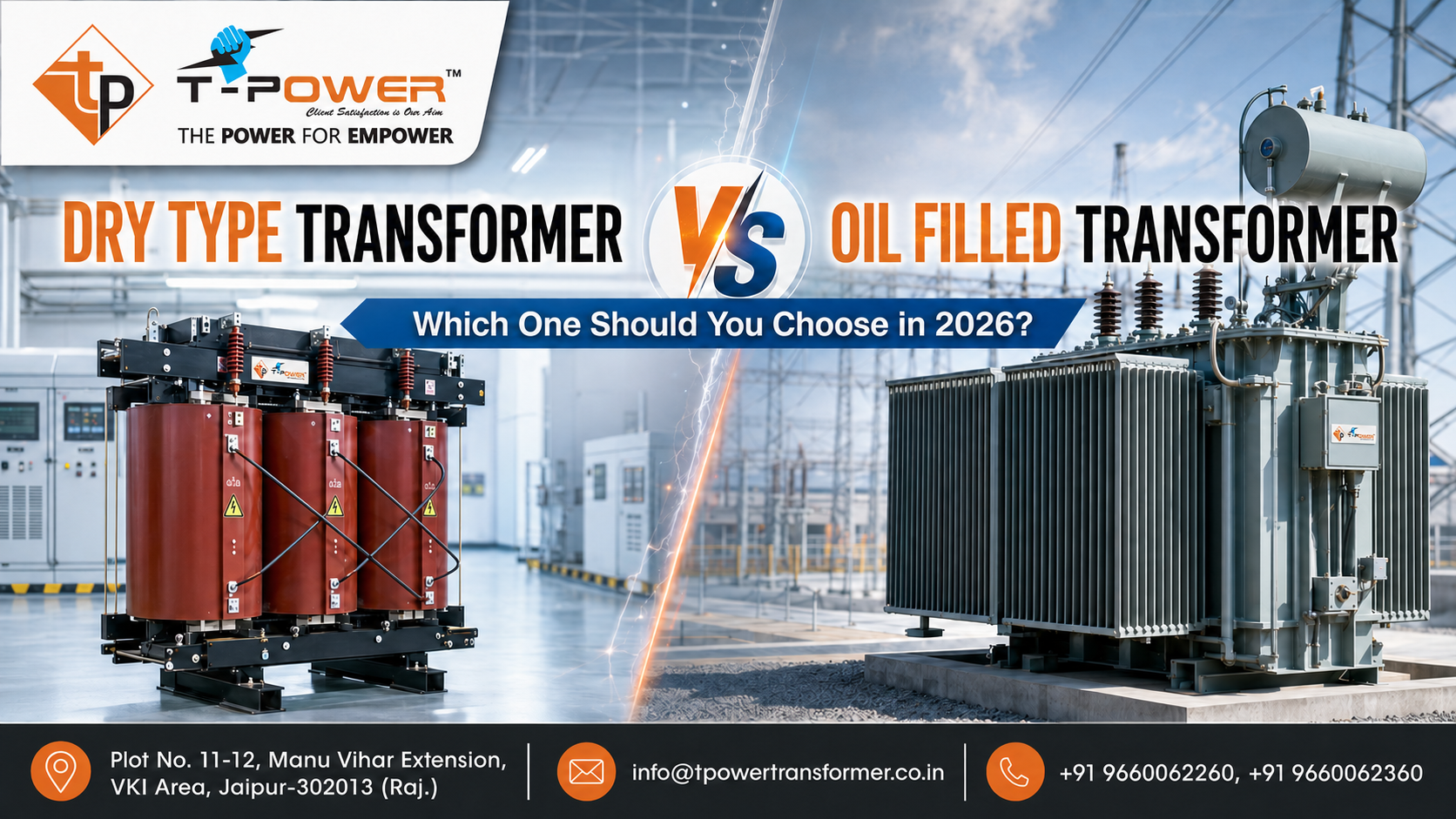
Dry Type Transformer vs Oil Filled Transformer: Which One Should You Choose in 2026?
Choosing between a dry type transformer and an oil filled transformer is not simply a question of selecting one technology over another. The correct decision depends on where the transformer will be installed, how much load it must carry, the surrounding environment, fire-safety expectations, maintenance resources, project budget, expansion plans and the cost of an unexpected shutdown. In 2026, this decision has become even more important because industrial facilities are operating with greater automation, renewable-energy systems are adding variable power flows, and asset owners increasingly expect real-time condition monitoring.
A dry type transformer uses air and solid insulation instead of insulating liquid for cooling and electrical isolation. An oil filled transformer, also called an oil immersed transformer, uses dielectric fluid to provide insulation and remove heat from the core and windings. Both technologies are proven, but each offers a different combination of safety, efficiency, size, maintenance and lifecycle cost. A transformer that performs exceptionally well at an outdoor utility substation may not be the safest choice inside a hospital basement. Similarly, a compact indoor transformer chosen only for low maintenance may not be the most economical solution for a large outdoor industrial load.
This detailed 2026 guide from T Power Transformer explains the difference in practical terms. It is written for plant owners, EPC contractors, electrical consultants, solar developers, facility managers and procurement teams seeking reliable Modern Transformer Solutions India. The objective is to help you build a clear technical requirement before requesting a quotation from a dependable Transformer Manufacturer Gujarat.
Quick Answer: Which Transformer Is Better?
Neither design is universally better. A dry type transformer is generally preferred for indoor installations, public buildings, fire-sensitive locations, mines, data centres, hospitals, metro infrastructure and sites where liquid leakage must be avoided. An oil filled transformer is often preferred for outdoor substations, utilities, renewable-energy plants, manufacturing units and higher-capacity applications where strong cooling, compact construction and good lifecycle economics are priorities.
- Choose dry type when indoor fire safety, low routine maintenance, clean operation and proximity to people are the dominant requirements.
- Choose oil filled when high capacity, better heat dissipation, outdoor durability, overload capability and initial cost efficiency matter most.
- Request a customized engineering study when harmonic loads, solar inverters, furnaces, frequent motor starting, high ambient temperature, altitude or non-linear equipment are involved.
The final selection must always be based on the approved electrical specification, applicable standards, site conditions and protection scheme. Price alone should never decide a transformer that may remain in service for decades.
What Is a Dry Type Transformer?
A dry type transformer has no liquid insulation. Its magnetic core and windings are cooled by natural air circulation or forced ventilation. The winding insulation may use vacuum pressure impregnation, resin-rich systems or cast resin depending on the design and application. Cast resin dry type transformers encapsulate the windings in resin, providing improved resistance to moisture, dust and certain aggressive environments. Ventilated dry type units use air passages and a protective enclosure to control access and cooling.
Because there is no transformer oil, the risk of an oil leak is removed and the combustible liquid inventory at the installation is reduced. This makes dry type transformers attractive for installations within or close to occupied buildings. Their enclosures can be selected according to required ingress protection, ventilation and environmental conditions. Temperature sensors in the windings can provide alarms or trip commands, while cooling fans may increase temporary loading capacity when properly engineered.
Dry type transformers are frequently used in commercial complexes, airports, hotels, hospitals, laboratories, schools, high-rise buildings, industrial indoor substations, tunnels, offshore facilities and locations with strict environmental controls. However, the room still requires adequate ventilation. Calling a transformer “dry type” does not mean it can be placed in any enclosed space without thermal planning.
What Is an Oil Filled Transformer?
An oil filled transformer places the core and windings inside a sealed tank filled with insulating fluid. The liquid performs two important functions: it provides dielectric insulation and transfers heat from active parts to the tank walls or radiators. Depending on rating and duty, cooling may be natural or assisted by fans and pumps. Conservator, sealed-tank and hermetically sealed arrangements are available for different service needs.
Oil immersed transformers have a long history in distribution, transmission and industrial power systems. Their excellent heat-transfer characteristics allow efficient designs across a wide range of ratings. The tank provides mechanical protection, while accessories such as oil level indicators, pressure relief devices, temperature indicators, Buchholz relays where applicable, marshalling boxes and monitoring sensors support safe operation.
These transformers are commonly installed at outdoor substations, factories, steel and cement plants, renewable-energy projects, infrastructure facilities, utilities and large commercial campuses. Correct bunding, fire separation, drainage, earthing, protection and oil-handling practices remain essential. Fluid selection should be discussed with the manufacturer when fire performance or environmental characteristics are especially important.
Dry Type vs Oil Filled Transformer: Detailed Comparison
| Selection Factor | Dry Type Transformer | Oil Filled Transformer |
|---|---|---|
| Cooling medium | Air with solid insulation; natural or forced ventilation | Insulating liquid with tank or radiator cooling |
| Typical location | Indoor and fire-sensitive installations | Outdoor substations and industrial power systems |
| Fire and leakage considerations | No insulating oil leakage; lower liquid-fire concern | Requires oil containment, fire planning and leak inspection |
| Heat dissipation | Generally less effective than liquid cooling for an equivalent compact size | Highly effective heat transfer and strong thermal performance |
| Maintenance focus | Cleaning, ventilation, connections, insulation and temperature checks | Oil quality, seals, leaks, breathers, accessories and electrical testing |
| Initial investment | Often higher for a comparable rating and specification | Often economical for many medium and high-capacity applications |
| Size and weight | Can require more space for cooling and clearances | Often compact for a comparable thermal duty, though tank and oil add weight |
| Environmental exposure | Needs a suitable enclosure and moisture/dust assessment | Tank construction is well suited to many outdoor conditions |
| Routine inspection | Relatively straightforward but not maintenance-free | More condition checks, especially for insulating oil and sealing |
| Common strengths | Indoor safety, clean operation and reduced liquid management | Efficiency, cooling, capacity range and lifecycle economics |
This comparison is directional. Actual performance depends on rating, voltage class, loss capitalization, impedance, insulation system, cooling class, enclosure, accessories and the manufacturer’s engineering. Two transformers with the same kVA nameplate can have meaningfully different losses, temperature rise, noise, dimensions and overload capability.
1. Safety and Fire Risk
Safety is usually the first reason a consultant considers a dry type transformer. Without mineral insulating oil, there is no risk of mineral-oil leakage inside the room and less combustible liquid to manage. This can simplify risk control in populated or enclosed buildings. Dry type equipment is therefore common near occupied floors, escape routes and sensitive processes, subject to local codes and the complete room design.
An oil filled transformer can also operate safely for many years when correctly manufactured, protected and installed. The project must provide appropriate separation, oil collection, fire detection, pressure protection and emergency procedures. Outdoor siting often makes these provisions easier. Alternative insulating fluids may offer different fire and environmental characteristics, but they must be technically evaluated rather than treated as a direct drop-in decision.
The correct safety comparison should include the entire installation: transformer, cable termination, switchgear, ventilation, civil room, drainage, fire barrier, relay coordination and operating procedures. Selecting dry type equipment does not eliminate electrical fire risk, and selecting oil filled equipment does not automatically create an unacceptable risk. Engineering quality determines the result.
2. Efficiency and Electrical Losses
Transformer efficiency depends on no-load loss, load loss, operating load profile and power quality. Oil filled designs often achieve strong thermal performance because the liquid removes heat efficiently. Dry type transformers can also be designed for low losses, but cooling constraints, enclosure arrangements and conductor temperature must be considered. Procurement teams should compare guaranteed loss figures at specified reference conditions instead of relying only on general assumptions about technology.
No-load loss is present whenever the transformer remains energized, even if the connected load is small. Load loss varies approximately with the square of current and becomes more influential during high loading. A facility operating continuously may save more over the transformer’s life by choosing lower guaranteed losses, even when the purchase price is higher. For a lightly used standby application, the economic balance can be different.
Ask the manufacturer for guaranteed losses, applicable tolerances, efficiency at relevant loading points and temperature-rise data. When comparing tenders, calculate the total cost of ownership using realistic energy tariffs and duty cycles. This is where a properly engineered Advanced Power Transformer can deliver value beyond its nameplate rating.
3. Cooling and Overload Performance
Oil has higher heat-transfer capability than air, which generally gives oil filled transformers an advantage in compact high-capacity applications. Radiators increase cooling surface, while fans or pumps can be incorporated in suitable designs. This thermal reserve may be valuable in factories with fluctuating load, high ambient temperatures or future capacity growth.
Dry type transformers depend on air pathways around and through the windings. Dust accumulation, obstructed ventilation, failed fans or excessive room temperature can reduce cooling. The installation designer must calculate heat rejection and ensure that intake and exhaust paths remain unobstructed. Air-conditioned transformer rooms are not automatically required, but ventilation must match transformer losses and site conditions.
Overloading should never be assumed from transformer type alone. Permissible loading depends on winding hot-spot temperature, insulation class, ambient conditions, previous load, cooling status and the manufacturer’s design. Repeated operation above the intended thermal limit accelerates insulation ageing in both technologies.
4. Installation Space and Location
Dry type transformers are widely selected for indoor electrical rooms because they avoid liquid containment and can be installed closer to the load centre when regulations permit. Placing the transformer near major loads can reduce low-voltage cable length, voltage drop and distribution losses. However, clearances, enclosure ventilation, acoustic treatment and access for replacement still require careful planning.
Oil filled transformers are commonly located outdoors in a dedicated yard or substation. The installation requires a foundation, safe access, fencing or enclosure, oil containment and adequate separation from buildings and other equipment. Cable routing and the distance to the low-voltage switchboard affect project cost. For larger capacities, outdoor oil filled equipment can be more practical than bringing a large dry type unit into a building.
Before ordering, verify the route from unloading point to final position. Door width, turning radius, crane access, floor loading, plinth height and maintenance clearances are easy to overlook. A technically correct transformer that cannot be moved into the electrical room creates an expensive site problem.
5. Maintenance Requirements
Dry type transformers are often described as low maintenance, but they are not maintenance-free. Dust and conductive contamination can accumulate on insulation and cooling passages. Loose terminations can produce local heating. Fans, controllers and temperature sensors require inspection. Periodic cleaning, thermography, insulation resistance testing, connection torque checks and ventilation inspection should be included in the maintenance plan.
Oil filled transformers require attention to oil level, leakage, gaskets, bushings, breathers, temperature indicators, pressure devices and the condition of insulating liquid. Oil testing can reveal moisture, dielectric strength and other indicators of asset health. For critical units, dissolved gas analysis may help identify developing thermal or electrical faults. Test selection and frequency should reflect rating, age, duty and criticality.
A good maintenance comparison therefore considers available staff and downtime windows. A remote facility with limited specialist support may value simple, digitally assisted inspections. A major industrial plant may already have an oil-testing programme and find oil immersed assets straightforward to manage.
6. Initial Cost vs Total Cost of Ownership
Dry type transformers frequently have a higher initial equipment cost for comparable ratings, particularly as capacity and voltage increase. Their overall project cost may nevertheless be competitive when reduced oil containment, simplified indoor fire provisions and placement near the load centre are considered. Oil filled transformers are often cost-effective at medium and higher ratings, but civil works, oil pits, fire separation and longer low-voltage cable runs can add to installed cost.
Total cost of ownership should include purchase price, civil work, switchgear integration, cable cost, energy losses, planned maintenance, spare parts, monitoring, downtime risk, expected life and end-of-life handling. The cheapest quotation may produce the highest operating cost if losses are excessive or the design is poorly matched to load.
For a realistic evaluation, request a bid comparison sheet using the same rating, vector group, impedance, tap range, temperature rise, loss requirement, accessories, enclosure and testing scope. Without a common specification, price comparisons are misleading.
7. Environmental and Site Conditions
Site conditions can change the selection. Dry type equipment installed in a humid, dusty, saline or chemically aggressive environment requires an appropriate insulation technology and enclosure. Condensation control may be necessary when the transformer cycles between cold shutdown and warm operation. Cast resin can improve resistance to some conditions, but the complete enclosure and ventilation design still matter.
Oil filled transformers have robust tanks that suit many outdoor environments, but corrosion protection, paint system, gaskets and accessories must match the climate. High ambient temperature affects cooling, while high altitude reduces air density and may require design corrections. Flood-prone sites require elevated placement and thoughtful cable entry. Coastal installations need attention to salt contamination and corrosion.
Provide the manufacturer with maximum and minimum ambient temperature, altitude, humidity, pollution level, indoor or outdoor location, enclosure requirement and seismic or wind conditions where relevant. Standard assumptions should not be used when actual site data is available.
8. Noise and Building Comfort
Transformer sound comes primarily from core magnetostriction, electromagnetic forces and cooling equipment. Noise can be important in hospitals, offices, hotels, residential developments and data centres. Dry type transformers located within a building may be closer to occupied areas, making acoustic planning essential. Oil filled units located outdoors may be farther from occupants, although large transformers and fans can still affect nearby spaces.
Do not depend on wall thickness alone. Specify the required sound level, avoid rigid structural paths that transmit vibration, use suitable anti-vibration arrangements and position ventilation openings carefully. Harmonic-rich loads may increase audible noise and heating. An experienced engineering team can review these conditions during design.
9. Service Life and Reliability
Both transformer types can provide long service when correctly designed, manufactured, installed and maintained. Insulation ageing is strongly influenced by temperature. Persistent overheating, overloads, poor connections, contamination and inadequate cooling reduce life regardless of whether the transformer uses air or oil.
Oil analysis provides valuable information about the internal condition of an oil filled transformer. Dry type equipment offers direct temperature monitoring and avoids fluid degradation, but internal insulation can still age and crack under severe thermal or mechanical stress. Reliability comes from controlling temperature, moisture, electrical stress and mechanical forces throughout the asset’s life.
Factory quality is equally important. Core construction, conductor material, winding geometry, insulation processing, clamping, tank fabrication, resin casting where applicable, drying, assembly and testing determine how the transformer behaves under real network events. This is why supplier evaluation should cover manufacturing capability rather than brochure claims alone.
Smart Transformer Technology in 2026
Smart Transformer Technology is changing how owners operate both dry type and oil filled transformers. Connected sensors and intelligent devices can collect temperature, current, voltage, load, power quality and cooling status. Oil filled transformers may also monitor oil level, moisture or gas-related parameters depending on asset criticality. Dry type units can monitor individual winding temperatures, fan stages and enclosure conditions.
The benefit is not simply having more data. A useful monitoring system converts readings into actionable alarms, trends and maintenance decisions. For example, a rising temperature at the same load can indicate blocked cooling, a fan problem or a deteriorating connection. Repeated current imbalance may reveal a distribution issue. Sudden gas generation in an oil filled unit can require urgent investigation.
In 2026, buyers should ask how monitoring data will be accessed, stored and integrated. Consider communication protocol, cybersecurity, alarm ownership, calibration, sensor replacement and compatibility with the plant’s supervisory system. A smart device that no one reviews does not improve reliability. The strongest approach combines good transformer design with a practical condition-based maintenance workflow.
Application-Based Recommendation Guide
Commercial Buildings and Shopping Complexes
Dry type transformers are often preferred because they can be installed indoors close to load centres and reduce oil-related fire and leakage concerns. Review room ventilation, sound levels, enclosure protection and future expansion. An outdoor oil filled unit may still be suitable when the campus layout provides a dedicated substation and sufficient separation.
Hospitals and Healthcare Facilities
Continuity, safety and low disruption are critical. Dry type transformers are commonly selected for indoor substations, while redundancy and coordinated protection are as important as transformer type. Critical medical loads should not depend on a single asset without an appropriate backup strategy.
Manufacturing Plants
The decision depends on capacity, process loads and location. Oil filled transformers are widely used for outdoor main substations and heavy industrial demand. Dry type units may distribute power inside production buildings. Facilities with large motors, welding equipment, variable-frequency drives or cyclic loads should provide detailed load data to the manufacturer.
Solar and Renewable-Energy Projects
Solar inverter transformers experience harmonic content, daily thermal cycling, voltage variation and application-specific duty. Oil filled inverter duty transformers are common in outdoor solar projects because of their thermal performance and rating flexibility. Dry type designs may suit particular indoor, rooftop or special fire-sensitive installations. The transformer must be engineered for the inverter system rather than selected as a generic distribution unit.
Data Centres
Data centres prioritise uptime, monitoring, redundancy, efficiency and indoor safety. Dry type transformers are frequently used, but the final architecture may include both technologies. Load profile, harmonics from power electronics, room temperature, sound, fault level and maintainability must be evaluated together.
Utilities and Outdoor Distribution Networks
Oil filled transformers remain a practical choice because they are well suited to outdoor service, broad capacity requirements and utility maintenance practices. Tank sealing, corrosion protection, losses, fault withstand and accessories should match network conditions.
Mines, Tunnels and Fire-Sensitive Sites
Dry type or specially engineered solutions may be favoured where liquid fire risk, ventilation constraints or environmental rules dominate. The applicable safety requirements, enclosure, flame behaviour and emergency access must be confirmed by the project consultant.
2026 Transformer Selection Itinerary: A Step-by-Step Roadmap
The following selection itinerary turns a broad enquiry into a purchase-ready specification. It helps avoid repeated revisions and ensures that quotations from different suppliers can be compared fairly.
Step 1: Define the Electrical Duty
State required kVA or MVA, primary and secondary voltage, system frequency, number of phases, vector group, earthing arrangement, impedance and tapping requirement. Mention whether tapping will be off-circuit or on-load. Provide fault level and protection information when available. If the transformer supplies a special load, identify it clearly.
Step 2: Record the Real Load Profile
List continuous load, peak load, duration of peaks, starting current, expected demand growth and daily operating hours. Separate linear and non-linear loads. Include large motors, UPS systems, rectifiers, variable-frequency drives, furnaces, welding machines and inverter equipment. A realistic profile helps optimize rating and losses.
Step 3: Confirm Installation Conditions
Specify indoor or outdoor placement, ambient temperature, altitude, humidity, dust, chemicals, coastal exposure, ventilation and enclosure protection. Share room dimensions and movement constraints for indoor installations. For outdoor units, provide plinth, access, drainage and fire-separation details.
Step 4: Rank Safety and Environmental Priorities
Decide whether avoiding insulating liquid is essential, whether oil containment is practical and how close the transformer will be to people or critical equipment. Review applicable building, fire, electrical and environmental requirements with qualified professionals. This step often determines whether dry type becomes the preferred option.
Step 5: Set Performance Requirements
Define guaranteed losses, temperature rise, sound level, insulation level, efficiency expectations, short-circuit withstand and overload needs. Do not use a generic “best efficiency” phrase. Measurable values make acceptance testing and commercial comparison clearer.
Step 6: Select Monitoring and Accessories
Choose temperature indicators, winding sensors, fan controls, remote alarm contacts, communication gateways and other accessories according to criticality. Oil filled units may require oil level indication, pressure relief, gas-actuated protection or additional condition monitoring. Confirm protocol and plant-system compatibility.
Step 7: Compare Lifecycle Cost
Evaluate equipment, civil work, cables, switchgear interfaces, energy losses, maintenance and downtime risk. Apply the same economic assumptions to every bid. A slightly higher purchase price can be justified when it reduces decades of operating losses or avoids expensive building modifications.
Step 8: Review Manufacturer Capability
Assess design experience, manufacturing processes, testing facilities, quality controls, customization capability, documentation and after-sales response. Ask for a clear drawing and data-sheet approval process. A capable Transformer Manufacturer Gujarat should understand the application instead of recommending a rating only from a short phone enquiry.
Step 9: Approve Drawings and Protection Interfaces
Review general arrangement, terminal orientation, cable-box details, dimensions, weight, foundation loading, clearances and accessory wiring before production. Coordinate relay settings, circuit-breaker rating, surge protection and earthing with the system designer.
Step 10: Plan Testing, Installation and Commissioning
Agree on routine tests, any specified special tests, documentation, inspection and dispatch conditions. At site, verify damage-free receipt, insulation condition, connections, earthing, oil level where applicable, protection operation and pre-energization checks. Preserve baseline readings for future maintenance comparisons.
Common Mistakes to Avoid in 2026
- Selecting only by kVA: Rating alone does not describe harmonics, load cycling, fault level, ambient temperature or future growth.
- Comparing only purchase price: Losses, cables, civil work, maintenance and downtime can exceed the initial price difference.
- Ignoring ventilation: Dry type transformers need reliable airflow, and inadequate room design can cause overheating.
- Ignoring oil containment: Outdoor oil filled installations require planned drainage, bunding and fire measures.
- Assuming low maintenance means no maintenance: Both technologies need inspection, testing and cleaning appropriate to their design.
- Using a standard transformer for special loads: Solar inverters, furnaces, rectifiers and VFD-heavy systems need application review.
- Ordering before checking access: Delivery path, lifting points, floor load and door dimensions must be verified.
- Adding sensors without a response plan: Monitoring creates value only when alarms and trends lead to timely action.
Questions to Ask a Transformer Manufacturer
- Which transformer type is recommended for our exact duty and why?
- What are the guaranteed no-load and load losses?
- What temperature rise and insulation system are proposed?
- How will ambient temperature, altitude and harmonics affect rating?
- What enclosure and cooling arrangement are included?
- Which accessories and protection interfaces are standard?
- Can monitoring integrate with our existing plant system?
- What routine and optional tests will be performed?
- What installation and commissioning support is available?
- What preventive-maintenance schedule is recommended?
Clear answers to these questions make technical evaluation easier and reduce the chance of hidden exclusions. They also demonstrate whether the supplier is proposing a product or a properly engineered solution.
Why Choose T Power Transformer?
T Power Transformer supports industrial, infrastructure and renewable-energy projects with application-focused transformer engineering. As a growing Transformer Manufacturer Gujarat, the company works with clients to understand voltage, rating, duty, installation environment and operating priorities before finalizing a design.
The product approach covers customized distribution, power, inverter duty and special-purpose requirements. Clients searching for an Advanced Power Transformer can discuss loss optimization, cooling, impedance, tapping, accessories and monitoring rather than accepting an unsuitable standard configuration. This focus supports dependable Modern Transformer Solutions India for factories, commercial facilities, EPC projects and clean-energy installations.
- Application-based dry type and oil filled transformer guidance
- Customized electrical and mechanical design options
- Support for industrial and renewable-energy duties
- Quality-focused manufacturing and testing
- Options for intelligent monitoring and protection interfaces
- Technical documentation and after-sales coordination
For the best result, share a single-line diagram, load list, site conditions and desired specifications with the engineering team. This allows T Power Transformer to recommend the correct technology and avoid both under-specification and unnecessary cost.
Frequently Asked Questions
Is a dry type transformer always safer than an oil filled transformer?
A dry type transformer removes insulating-oil leakage and reduces liquid-fire concerns, which is valuable indoors. However, overall safety also depends on electrical protection, clearances, enclosure, ventilation, earthing, cable termination and maintenance. A correctly installed oil filled transformer can be safe and reliable, especially in a dedicated outdoor substation.
Which transformer is more efficient?
Efficiency cannot be decided only by the words “dry type” or “oil filled.” Oil filled designs often benefit from effective cooling, but both technologies can be engineered for low losses. Compare guaranteed no-load and load losses at the intended duty and calculate lifecycle energy cost.
Which transformer requires less maintenance?
Dry type transformers generally avoid oil testing, filtration and leak management. They still require cleaning, connection inspection, temperature monitoring and ventilation checks. Oil filled transformers need oil and sealing-system attention but may be familiar and practical for industrial maintenance teams.
Can a dry type transformer be installed outdoors?
It can be used outdoors only with a properly engineered weatherproof enclosure, suitable insulation system and environmental assessment. Heat dissipation, condensation, dust, rain and corrosion must be considered. Outdoor installation should never be assumed from the transformer name alone.
Can an oil filled transformer be installed indoors?
Indoor installation may be possible subject to applicable codes, fire protection, oil containment, ventilation, access and building design. Many projects prefer dry type equipment indoors because it simplifies some oil-related concerns. The consultant and local authorities should confirm requirements.
Which transformer is better for solar plants?
Oil filled inverter duty transformers are common in outdoor utility-scale projects because of thermal performance and capacity flexibility. Dry type transformers can suit selected indoor or special applications. Harmonics, inverter output, voltage variation, duty cycle and site temperature must be included in the design.
How should transformer capacity be selected?
Capacity should be based on present maximum demand, diversity, load type, starting requirements, harmonics, ambient conditions and planned growth. Oversizing increases capital cost and may increase the influence of no-load losses; undersizing creates overheating and reliability risk. A load study provides the best basis.
What is the role of Smart Transformer Technology?
It provides continuous or periodic visibility into operating conditions such as load, voltage, current, temperature, cooling status and selected health indicators. Trend analysis can support predictive maintenance, but sensor data must be connected to defined alarm and response procedures.
What information is required for a transformer quotation?
Provide rating, voltages, phases, frequency, vector group, impedance, tapping, cooling, installation location, ambient temperature, altitude, enclosure, losses, accessories, special loads and applicable specifications. A single-line diagram and load profile are highly useful.
How often should a transformer be inspected?
Inspection frequency depends on rating, environment, loading, criticality, manufacturer guidance and regulatory requirements. Critical industrial assets may need continuous monitoring plus planned inspections, while lower-risk units may follow a periodic schedule. Baseline data and trend changes are more useful than a one-size-fits-all interval.
Final Verdict: Dry Type or Oil Filled?
Choose a dry type transformer when the project prioritises indoor installation, reduced liquid-fire concerns, clean operation and lower oil-related maintenance. Choose an oil filled transformer when the project needs strong heat dissipation, high capacity, outdoor service, competitive initial economics and proven performance under industrial or utility duty.
For many large facilities, the correct answer may be a combination: an oil filled main transformer in an outdoor substation and dry type distribution transformers near indoor load centres. This hybrid arrangement can balance efficiency, cable length, safety and maintainability. The architecture should be decided using a complete power-system study rather than a general preference.
In 2026, the strongest transformer purchase is one that combines correct sizing, guaranteed performance, site-appropriate insulation, coordinated protection and meaningful condition monitoring. Work with a manufacturer that asks detailed questions, explains trade-offs and supports the asset after dispatch.
Need help selecting the right transformer? Contact T Power Transformer for customized dry type, oil filled, industrial and renewable-energy transformer solutions designed around your electrical duty and installation conditions.

